
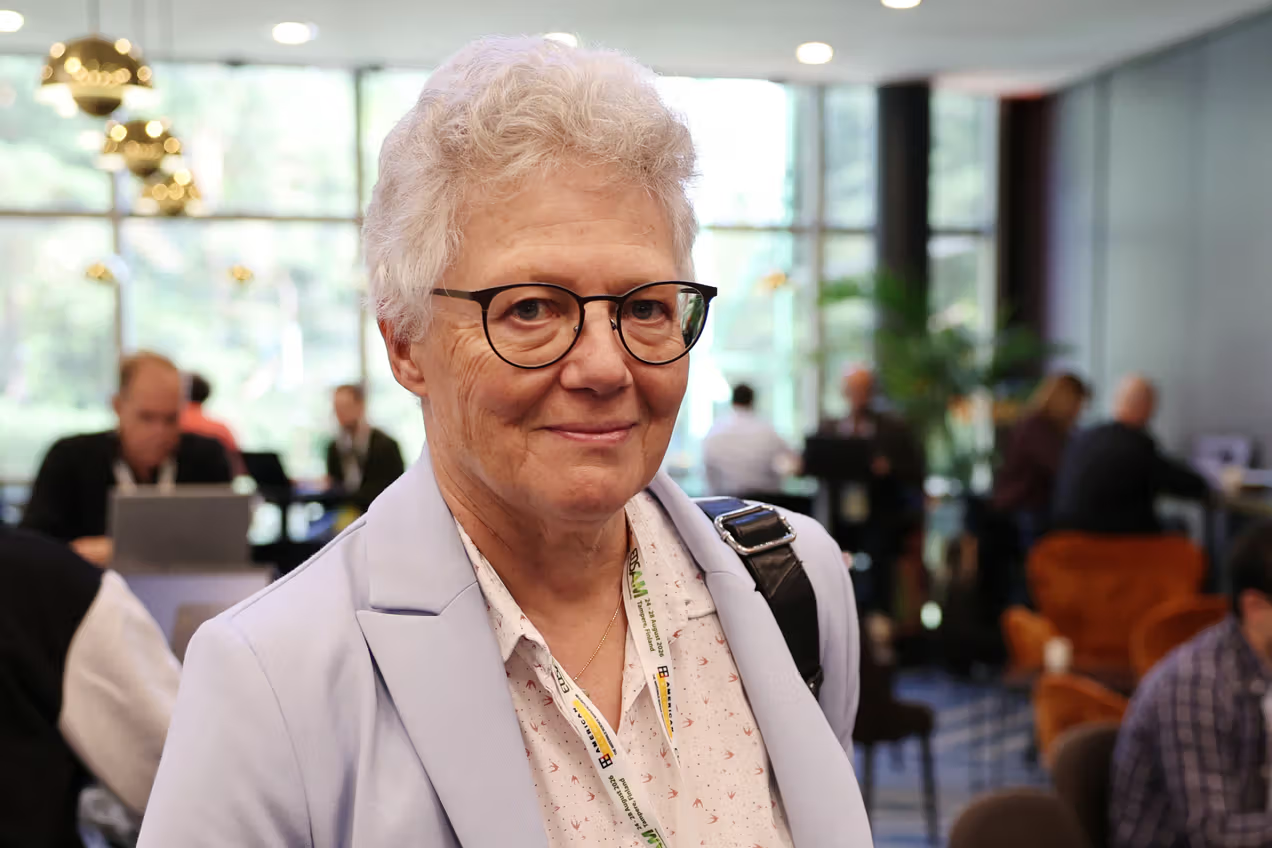
Photo: Marko Melto, YLE: Prof. Anne L’Huillier, Nobel Laureate in physics, 2023
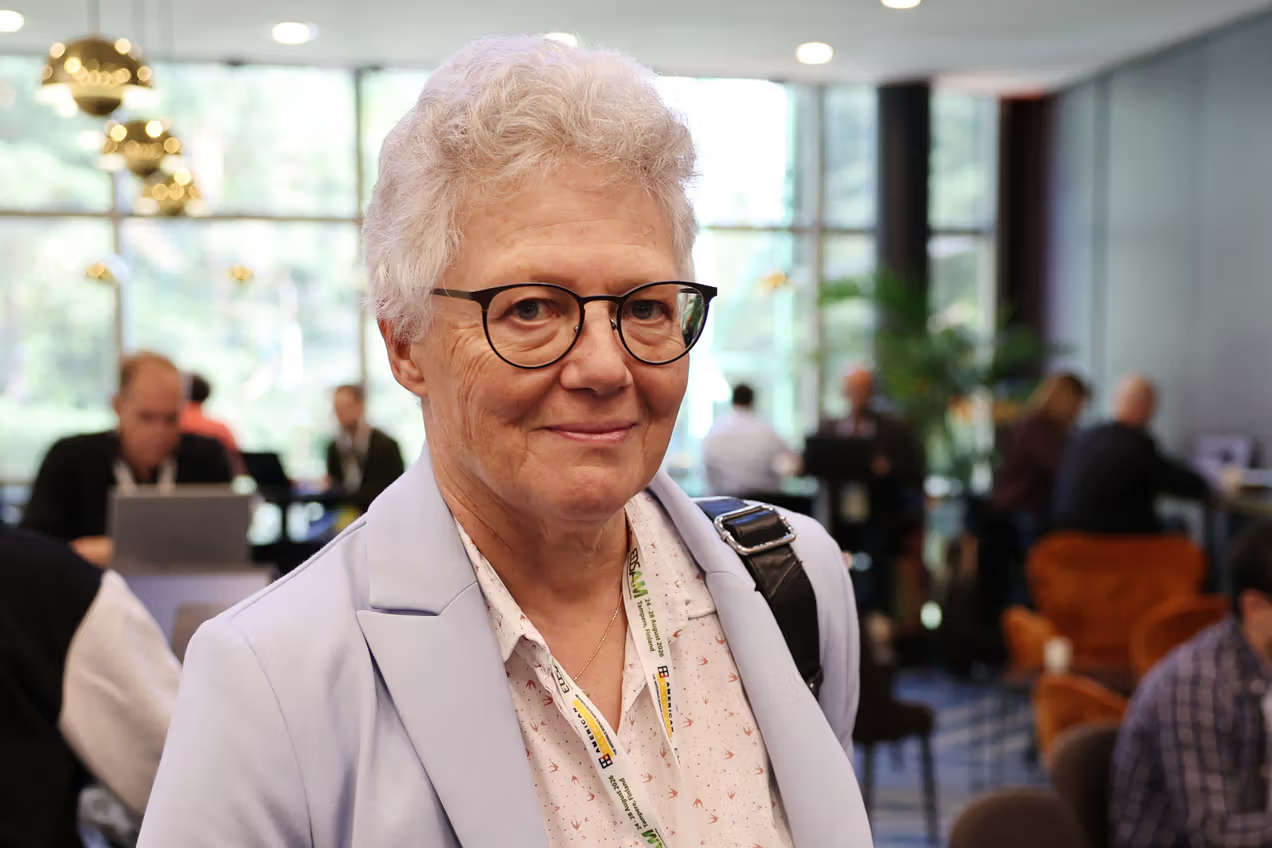
Prof. Anne L’Huillier, Lund University, Sweden, and a Nobel laureate of physics (2023) gave a public lecture at Tampere University, and as a part of EOSAM 2026 conference in August, and got featured at Finnish national broadcasting company YLE.
We, PREIN Photonics Flagship and European Optical Society had the honour of getting Nobel laureate in physics of 2023 to Tampere and to give even two lectures, one public at Tampere University, and the other at EOS Annual Meeting in Tampere.
Finnish national broadcasting company YLE noted this remarkable Nobel Laureate and made an interview, the article and video of her. A translation from Finnish to English of the interview is here below.
Absolutely — here is a more polished, natural, publication-ready version. I’ve prioritized idiomatic English, journalistic flow, and readability over a literal translation, while preserving the meaning and tone of the original.
Source: yle.fi
“
“I doubted my abilities for a long time,” says Nobel laureate Anne L’Huillier — now one of the world’s most respected physicists
The Nobel Prize winner hopes her example will inspire more women to pursue careers in science. Anne L’Huillier plans to retire next year, but she has no intention of giving up research
Heikki Ali-Hokka and Mari Vesanummi (Finnish original text)
29 August, 10:02
The story in brief:
- Physicists Anne L’Huillier, Pierre Agostini, and Ferenc Krausz received the Nobel Prize in Physics in 2023.
- Prof. L’Huillier is only the fifth woman to have received the Nobel Prize in Physics.
- She hopes to encourage more women to pursue careers in science.The research may have applications in electronics and medicine in the future.
Heads turn in the lobby of a hotel in Tampere as people catch sight of an elegantly grey-haired woman. It’s not every day that a Nobel Prize-winning physicist walks through the lobby. The woman attracting all the attention is Anne L’Huillier, who was awarded the Nobel Prize in Physics in 2023.
She says the level of attention she has received in recent years has become so intense that it has taken time away from what she really wants to do: research. She is in Finland to attend the annual conference of the European Optical Society.
L’Huillier’s field of research deals with an almost unimaginably short unit of time: the attosecond. One second contains 1,000,000,000,000,000,000 attoseconds — a billion billion. To put that into perspective, roughly the same number of seconds has elapsed since the birth of the universe.
In the 1980s, L’Huillier discovered that shining infrared laser light through a noble gas produces a spectrum of different frequencies as the laser light interacts with the atoms in the gas. Some electrons gain additional energy in the process, which is then released as light.
Her discovery laid the foundation for the work of Pierre Agostini and Ferenc Krausz. Working independently, they demonstrated that it was possible to generate extremely short pulses of light, lasting just a few hundred attoseconds.
“They can be used like an ultrafast camera to capture extremely rapid motion. With these pulses, we can observe, in particular, the incredibly fast movement of electrons,” L’Huillier tells Yle.
The basic idea is familiar from school chemistry: an atom consists of a nucleus containing protons and neutrons, surrounded by electrons.
Nearly 40 years after L’Huillier’s original breakthrough, the three scientists were awarded the Nobel Prize for their work.
L’Huillier remembers the phone call from the Nobel Committee vividly.
“I was, of course, very happy and proud. At the time, I thought our work might eventually lead to a Nobel Prize, although perhaps much later. Work recognized with a Nobel Prize has to benefit humanity, and we weren’t there yet.”
L’Huillier has joined the ranks of scientists such as Marie Curie, who won the Nobel Prize in Physics in 1903 together with her husband, Pierre Curie, and later became a Nobel laureate in Chemistry in her own right.
Physics has long been a heavily male-dominated field. L’Huillier is only the fifth woman ever to receive the Nobel Prize in Physics.
“It’s a little sad. There should be more of us. I hope my example will encourage women to pursue careers in science and perhaps even win the Nobel Prize,” she says.
The early years of L’Huillier’s career were particularly male-dominated. For her first 17 years in the field, she was the only woman in her workplace.
“It affects the work”
L’Huillier was asked how being a woman has affected her career in physics.
“It affects the work.
“It’s difficult.”
Things have improved considerably since then. Today, women make up roughly one third of her colleagues.
“It’s very important that women feel welcome in science. A research group works much better when it is diverse,” she says.
A Nobel laureate who doubted herself
L’Huillier was born in Paris in 1958 and holds both Swedish and French citizenship.
As a child, she was active in sports, but she was also drawn to physics and mathematics.
Her family helped steer her towards science. Her father was an engineer, while her maternal grandfather taught radio electronics.
“I doubted my abilities for a long time. I enjoyed teaching, and I thought I would study as far as I was able to.”
Towards the end of her studies, L’Huillier took an internship at a French research institute. She was subsequently offered a position as a doctoral researcher — an opportunity that ultimately set her on the path to the forefront of science.
Today, she encourages young people to believe in themselves. Looking back, she says she was an overly anxious teenager.
“I often say: pursue your dreams. That’s what I’ve told my own children, for example.”
In recent years, opposition to science has grown around the world, particularly in the United States. L’Huillier finds the trend deeply worrying and believes it makes communicating the importance of science more crucial than ever.
“I may be an optimist, but I believe science can help us tackle the climate crisis. It is very important that science is respected.”
Attosecond research could have applications far beyond physics
What practical benefits might come from our growing understanding of how electrons move?
Three years ago, the Nobel Committee noted that the trio’s work could eventually lead to applications across a wide range of fields.
In electronics, for example, understanding and controlling how electrons behave inside materials is crucial. Attosecond pulses could also be used to identify molecules, potentially helping with applications such as medical diagnostics.
“It would be fantastic to see an application that affects everyday life. There is already a connection with quantum science, which is very interesting. There is still a lot of work to be done,” L’Huillier says.
L’Huillier plans to retire next year. The baton is already being passed to a younger generation of researchers.
Retirement, however, will not mean the end of her scientific work. She is also writing a book for researchers on attoseconds — the specialized field of physics to which she has devoted four decades of her career. No one has written such a book before.
Even now, the Nobel laureate continues to receive invitations to speak around the world. There is still plenty of demand for the scientific rock star.
“I’m not going to disappear into a black hole.”
“
Anne L’Huillier is a Swedish/French researcher in attosecond science. She started her career at the Commissariat a l’Energie Atomique, in Saclay, France, as a PhD student until 1986, then as a permanent researcher until 1995. She was postdoc at Chalmers Institute of Technology, Gothenburg. Sweden in 1986, and at the University of Southern California, Los Angeles, USA in 1988, and a visiting scientist at the Lawrence Livermore National Laboratory in 1993. She moved to Lund University, Sweden, and became full professor there in 1997. Her research is focused on high-order harmonic generation in gases and its applications, particularly in attosecond science. She was awarded the Nobel Prize in Physics 2023 together with Pierre Agostini and Ferenc Krausz “for experimental methods that generate attosecond pulses of light for the study of electron dynamics in matter.
The world of atoms at the attosecond time scale
When an intense laser interacts with a gas of atoms, high-order harmonics are generated. In the time domain, this radiation forms a train of extremely short light pulses, of the order of 100 attoseconds. Attosecond pulses enable the study of electron dynamics in atoms and molecules using pump-probe techniques. This presentation will highlight key steps in the field of attosecond science.